
- Who inherits if there is no will?
- What does a husband, wife or civil partner get?
- What do children get?
- Does my partner inherit if we are not married?
- What happens if there is no family?
- Who deals with the estate if there is no will?
- What doesn't pass under the intestacy rules?
- How a will changes this
If you die without a will, the intestacy rules decide who inherits, in a fixed order of family members. A partner you were not married to or in a civil partnership with doesn't inherit anything under the rules.
What happens if you die without a will? Your money, property and possessions (your estate) are shared out under fixed legal rules called the intestacy rules (also known as the rules or laws of intestacy).1 Dying without a will is also called dying intestate. The rules set out who inherits, in a fixed order of family members. They can't take account of what you would have wanted.1
This guide covers the intestacy rules in England and Wales.
Who inherits if there is no will?
The table below is a quick summary of who inherits if no will has been made.1
| Your situation when you die | Who inherits |
|---|---|
| Married or in a civil partnership, with children | Your husband, wife or civil partner gets your personal possessions, the first £322,0002 and half of the rest. Your children share the other half. |
| Married or in a civil partnership, no children or grandchildren | Your husband, wife or civil partner gets everything. |
| Not married or in a civil partnership, with children | Your children share everything equally. |
| Not married or in a civil partnership, no children or grandchildren | Other relatives, in the order shown below. |
| None of these relatives alive | The Crown. |
If you leave no husband, wife, civil partner, children or grandchildren, your estate goes to the first group in this list that has someone alive:1
- Your parents, in equal shares
- Your brothers and sisters who share both your parents
- Your half brothers and sisters
- Your grandparents
- Your aunts and uncles who were full brothers and sisters of your parent
- Your aunts and uncles who were half brothers and sisters of your parent
Our intestacy rules flowchart below goes through each group in more detail.
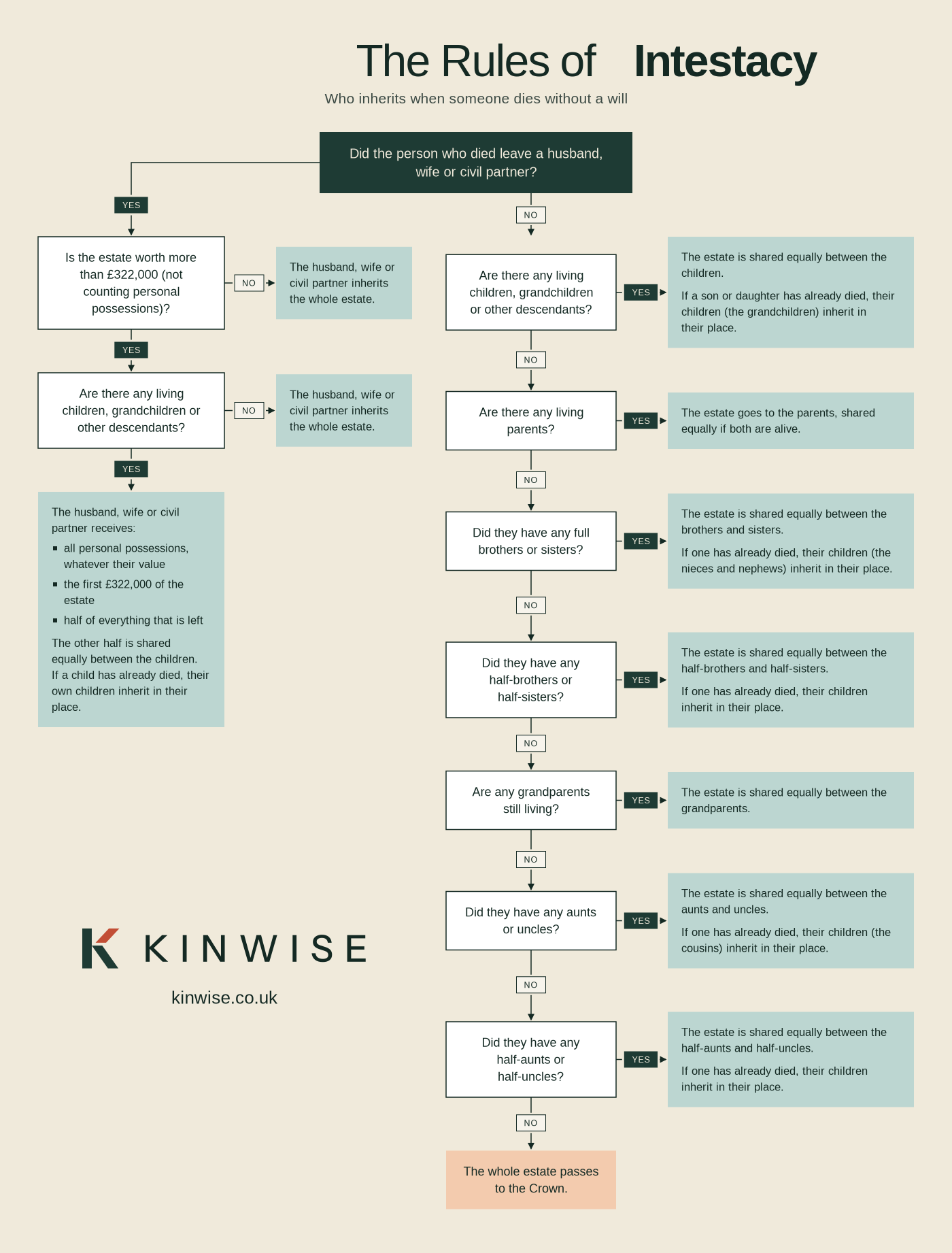
What does a husband, wife or civil partner get?
If you have children, your husband, wife or civil partner gets:1
- your personal possessions. These are physical things you own, such as furniture or jewellery, but not money, investments, or items used mainly for business.3
- the first £322,000 of the rest of your estate. This figure has applied since 26 July 2023.2,4
- half of whatever is left after that.
Your children share the other half. If you have no children or grandchildren, your husband, wife or civil partner inherits everything.1
Your husband, wife or civil partner must outlive you by 28 days to inherit. If they die within 28 days of you, the rules treat them as if they had died first.1
What do children get?
Your children share their part of your estate equally. A child under 18 can't inherit straight away. Their share is held for them until they turn 18, or until they marry or form a civil partnership if that happens first.5
If one of your children died before you, their children (your grandchildren) take the share their parent would have had.5
An adopted child is treated in law as the child of the people who adopted them, so they inherit in the same way as any other child.6,7 Stepchildren who were not legally adopted don't inherit under the intestacy rules.7
Does my partner inherit if we are not married?
No. The intestacy rules only provide for a husband, wife or civil partner.1 A partner you were not married to or in a civil partnership with doesn't inherit anything under the rules.7
An unmarried partner may be able to apply to court for reasonable financial provision from the estate. This is under the Inheritance (Provision for Family and Dependants) Act 1975. A partner can apply if, for the whole two years before the death, they lived in the same household as the person who died, as if they were a married couple or civil partners. Someone who was being supported financially by the person who died can also apply.8
A claim normally has to be made within six months of the date someone is first given legal authority to deal with the estate. The court can allow a later claim.9 Legal advice can help you decide whether to make a claim.
What happens if there is no family?
If none of the relatives listed above are alive, your estate passes to the Crown as bona vacantia, which means ownerless property.10 The law says it goes to the Crown, the Duchy of Lancaster or the Duke of Cornwall.1
Who deals with the estate if there is no will?
With no will, there are no executors named to deal with your estate. Instead, the closest living relative can apply for the legal right to deal with it.11 They apply for letters of administration, which prove their legal right to manage the estate.12
The order of who can apply is:13
- Your husband, wife or civil partner
- Your children, and the descendants of any child who died before you
- Your parents
- Your brothers and sisters who share both your parents, and the descendants of any who died before you
- Your half brothers and sisters, and the descendants of any who died before you
- Your grandparents
- Your aunts and uncles who were full brothers and sisters of your parent, and the descendants of any who died before you
- Your aunts and uncles who were half brothers and sisters of your parent, and the descendants of any who died before you
What doesn't pass under the intestacy rules?
Some things pass straight to someone else, whatever the intestacy rules say:
- Property owned as joint tenants automatically passes to the surviving owners.14,11
- Money in a joint bank account with your partner passes to them automatically.7
If you own a home as tenants in common, your share does not automatically pass to the other owner.7 With a will, you can choose who gets your share.14
How a will changes this
A will lets you decide who inherits your estate,15 including people the intestacy rules leave out, such as an unmarried partner, stepchildren or friends. If a will only covers part of your estate, the intestacy rules still apply to the part it doesn't cover.16
If you'd like to set out your own wishes, you can make your will online with Kinwise.
Ready to make your will?
Every will is professionally checked before you sign.
Make Your Will Online →Frequently asked questions
No. This guide covers England and Wales. Scotland and Northern Ireland have their own probate rules, so check the guidance for where the person lived.11
This guide is general information about the law in England and Wales, not legal advice for your situation. Facts and figures were true at the time of writing. Last reviewed 18 October 2026.
Sources
- Administration of Estates Act 1925, s.46. www.legislation.gov.uk/ukpga/Geo5/15-16/23/section/46 (accessed 18 October 2026)
- The Administration of Estates Act 1925 (Fixed Net Sum) Order 2023. www.legislation.gov.uk/uksi/2023/758/made (accessed 18 October 2026)
- Administration of Estates Act 1925, s.55(1)(x), "personal chattels". www.legislation.gov.uk/ukpga/Geo5/15-16/23/section/55 (accessed 18 October 2026)
- HMRC Trusts, Settlements and Estates Manual, TSEM7828: Intestacy, England and Wales, fixed sums. www.gov.uk/hmrc-internal-manuals/trusts-settlements-and-estates-manual/tsem7828 (accessed 18 October 2026)
- Administration of Estates Act 1925, s.47. www.legislation.gov.uk/ukpga/Geo5/15-16/23/section/47 (accessed 18 October 2026)
- Adoption and Children Act 2002, s.67. www.legislation.gov.uk/ukpga/2002/38/section/67 (accessed 18 October 2026)
- Citizens Advice, Who can inherit if there is no will: the rules of intestacy. www.citizensadvice.org.uk/family/death-and-wills/who-can-inherit-if-there-is-no-will-the-rules-of-intestacy/ (accessed 18 October 2026)
- Inheritance (Provision for Family and Dependants) Act 1975, s.1. www.legislation.gov.uk/ukpga/1975/63/section/1 (accessed 18 October 2026)
- Inheritance (Provision for Family and Dependants) Act 1975, s.4. www.legislation.gov.uk/ukpga/1975/63/section/4 (accessed 18 October 2026)
- GOV.UK, Unclaimed estates (bona vacantia). www.gov.uk/unclaimed-estates-bona-vacantia (accessed 18 October 2026)
- GOV.UK, Applying for probate. www.gov.uk/applying-for-probate (accessed 18 October 2026)
- GOV.UK, Apply for probate by post if there is not a will (form PA1A). www.gov.uk/government/publications/apply-for-probate-by-post-if-there-is-not-a-will (accessed 18 October 2026)
- Non-Contentious Probate Rules 1987, r.22. www.legislation.gov.uk/uksi/1987/2024/rule/22 (accessed 18 October 2026)
- GOV.UK, Joint property ownership. www.gov.uk/joint-property-ownership (accessed 18 October 2026)
- Wills Act 1837, s.3. www.legislation.gov.uk/ukpga/Will4and1Vict/7/26/section/3 (accessed 18 October 2026)
- Administration of Estates Act 1925, s.49. www.legislation.gov.uk/ukpga/Geo5/15-16/23/section/49 (accessed 18 October 2026)
- Matrimonial Causes Act 1973, s.18. www.legislation.gov.uk/ukpga/1973/18/section/18 (accessed 18 October 2026)
- Inheritance Tax Act 1984, s.142. www.legislation.gov.uk/ukpga/1984/51/section/142 (accessed 18 October 2026)